Specifications
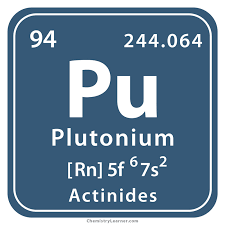
| Atomic number | 94 |
| Atomic mass | 244 |
| Boiling point | 5855 C |
| melting point | 64 C |
| State | Solid |
| Density | 19.86 g/cm³ |
History
First produced and isolated in December 1940 by Glenn Seaborg, Edwin McMillan, Joseph Kennedy, and Arthur Wahl at the University of California, Berkeley, by bombarding uranium with deuterons. Initially kept secret during World War II, this man-made, radioactive element was identified as a superior fissile material for atomic weapons. It was later used in the “Fat Man” bomb dropped on Nagasaki in 1945.
Where its used
Plutonium is primarily used in nuclear weapons (as plutonium-239) and nuclear reactors (as a fuel component in MOX fuel), but also powers spacecraft via heat from plutonium-238 in radioisotope thermoelectric generators (RTGs) for satellites and probes, and even powers some medical devices like pacemakers. It’s a byproduct of nuclear fission in reactors, separated for reuse or stored in spent fuel.